Context: Activision/Infinity Ward have increased their output of information for the upcoming release of Call of Duty: Modern Warfare. As part of this, killstreaks have been confirmed for multiplayer.
https://twitter.com/CallofDuty/status/1155886018232328192
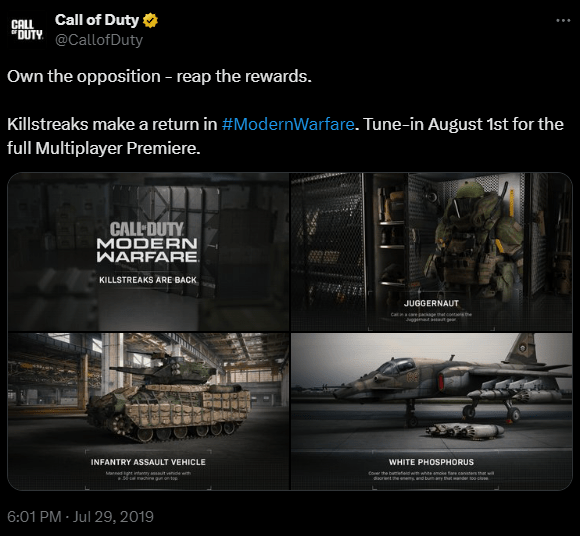
Unsure why the inclusion of White Phosphorus has now garnered such a reaction from gaming outlets – baffling on many fronts for me personally. To explain White Phosphorus – it’s an incendiary weapon with its main use as cover for combat movement due to its ability to create smoke rapidly. It also has the ability to ignite and burn vociferously which can cause horrific injuries to those that come into contact.
The reaction, to sum it up, has questioned the use of a controversial weapon offered in such a glib manner. Eurogamer, Kotaku and Polygon have drawn comparisons between the serious nature of the single-player campaign; that is attempting to contrast a more nuanced view of war and its obscene effects with the almost celebratory worship of weaponry and munitions in multiplayer. This is why I feel like there has been a missed opportunity – there’s a natural discussion to have here about how we treat violence and warfare as entertainment in video games, where currently, serious subject matters are used as a currency to keep player engagement. None of the reactions, so far, has offered a nuanced view on this – specific to Call of Duty itself or a wider discussion about the medium as a whole.
Let’s start with the obvious issue I’ve taken with this reaction – White Phosphorus is seen as a step too far and insensitive for its inclusion in multiplayer/”celebrated” in this manner. The tension that it creates for me is that other heinous methods previously used as killstreaks have not been met with the same disdain. The unintended consequence of writing about WP is the implicit embrace of those said methods. Call of Duty has seen the use of carpet bombing, MOABs and nukes in its multiplayer and again, I don’t remember a reaction being offered on this – which implies them as being acceptable weapons to use. Those previous methods could even be argued to be more indiscriminate and destructive than the use of WP – but again, there’s tacit acceptance that the other killstreaks are an accepted “default” for multiplayer.
It also shows you how normalised drone strikes have become when they have not been treated as an indiscriminate weapon that has caused the deaths of a significant number of innocent civilians across the world. Granted, drone strikes have not been included in this year’s Call of Duty so far, but I will be curious to see how the press reacts if they do appear.
Spec Ops: The Line has also been invoked in this discussion as a careful handling of the use of WP in gaming – there’s a moment in the game where the player is asked to drop WP on a specific target. After the area has settled, the player is confronted with result of that decision – your attack was not launched on suspected militants but on a convoy of civilians. It demonstrates this by showing the charred remains of its victims, homages as statues to the barbarity.
But it’s a red herring. The poignancy of that moment is precisely because it was meted out on innocent civilians. Had the convoy been full of soldiers, it would not have created the regret but seen as unfortunate but necessary decision.
There is no indication that Call of Duty: Modern Warfare will include civilians in its multiplayer and there is no suggestion that WP will be deployed on civilian targets (in multiplayer).
It could also be argued that the overall poignancy of Spec Ops, to show the destruction of war, is punctured by its inclusion of multiplayer. In other words, that simulated war could be used as entertainment (which may be seen as the antithesis of what the game was aiming to achieve). The fact that the multiplayer has been forgotten surely provides a precedent that poignant messaging could live long in the memory.
There exists a counter-argument that WP being deployed as a weapon per se ie used an incendiary device aimed at combatants would be in contravention of the “UN Convention on Prohibitions or Restrictions on the use of certain conventional weapons which may be deemed to be excessively injurious or to have indiscriminate effects”. That point has been answered with the tacit acceptance of other methods (to name others – IEDs, bouncing beatties, napalm) as being acceptable killstreaks. It can also easily be sidestepped by the developers to suggest that it is for the use of illumination or obfuscation (just like in real war).
There’s also stark need for a discussion about the treatment of injured soldiers in these games. The killing of injured soldiers is strictly prohibited by the Geneva Conventions. I, again, don’t believe that this has been used as a serious starting point for depictions of war in games – where a wider discussion could take place about the vast limitations of the medium or the leisurely pace of the medium’s maturation in order demonstrate the full spectrum of what takes place. Don’t even get me started on torture.
Polygon sought to include an example of the use of WP in the battle of Fallujah during the second Gulf war. I would have welcomed more context on this to fully demonstrate the effects of WP being used – I wish the article had gone further. The most poignant example of its use that exists in my mind is when the IDF dropped WP munitions onto a UN school during Operation Cast Lead in 2008/9. The horrors of seeing mothers and children trying to escape are deeply etched in my memory – what a brave discussion to have in order to explain why the use of WP is so controversial. And again, imagine if that led into a wider discussion about the use of violence and execution of war in gaming and how that may need to be re-examined.
The failures can be summed up here – failure to questions use of previous killstreaks, failure to demonstrate full barbarity of WP, failure to invoke specific examples to demonstrate controversy of WP, failure to have a discussion about the committal of “simulated war crimes” already in games, failure to have a wider discussion about violence as a tool in gaming, failure to have a discussion about what is acceptable or not in this medium.
What we do have is a mealy-mouthed collection of a few paragraphs that seemed to be more interested in peacocking, which inadvertently serves as marketing in increasing the game’s notoriety rather than a sober discussion of the medium.
This is really an indictment on how inchoate the gaming press are – unwilling or unable to have serious discussions about difficult subject matters.
 gamesandtings
Leave a comment