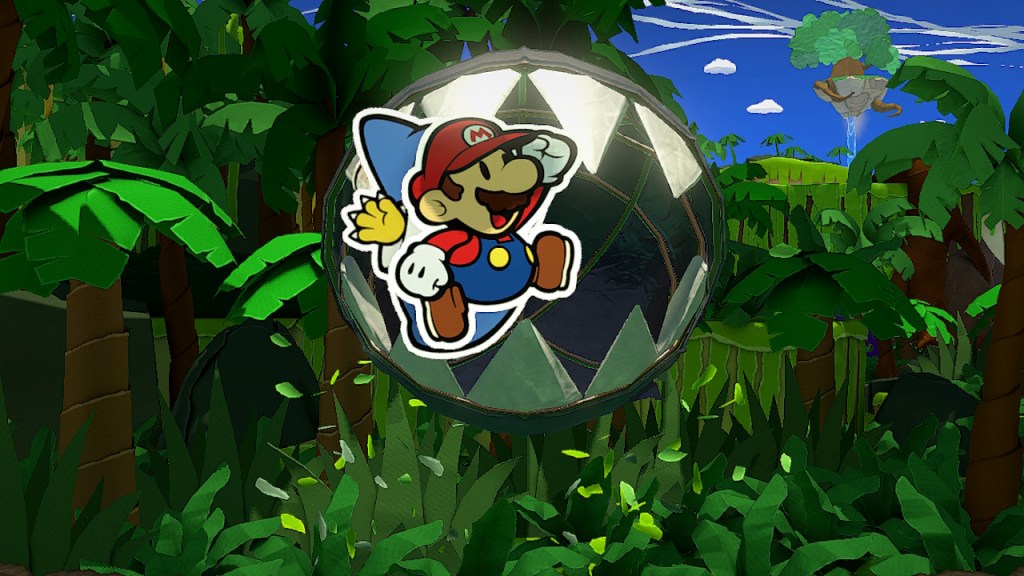
I’m only 4 and a half years late and I regret waiting so long to even play it.
The game is a delight, pure and simple. It has fun with all the baggage and heritage that comes with Mario games (even specifically, Paper Mario games) rather than coming across like it is crushed with unrealistic expectations.
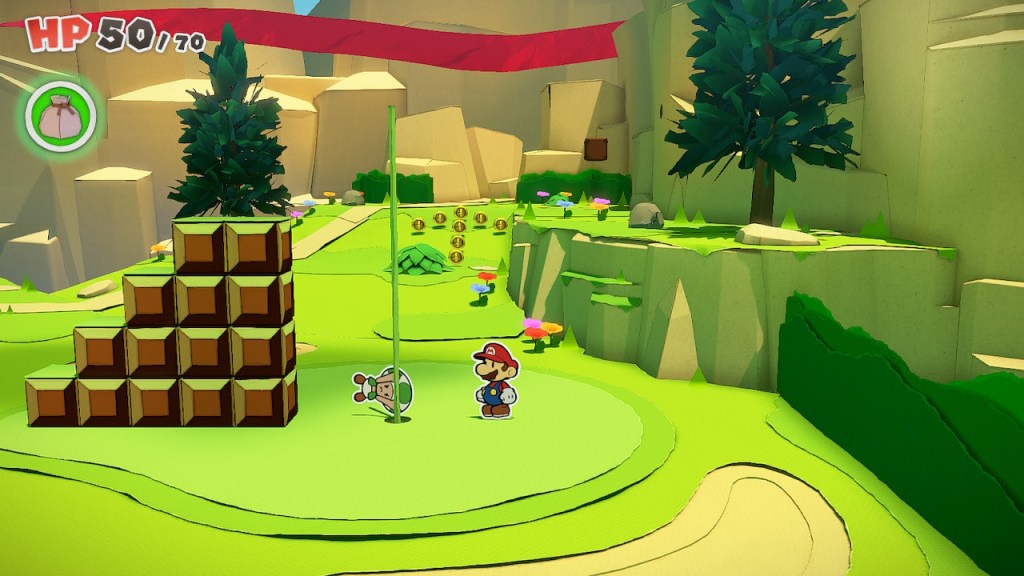
Paper Mario Series
The Paper Mario series has had a bit of a rough time with recent entries, namely with Sticker Star that released on the 3DS all the way back in 2012. “Fans” aka online weirdos that wanna forehead kiss Thousand Year Door (with or without consent) lament the fact that the Paper Mario series has decided to move in a different direction i.e. to be less RPG-like but still retaining the aesthetic and feel of a traditional Paper Mario game. Gone are experience points, levelling up stats, badges to wear for additional perks, varied partners and environments AND the use of powerful magical attacks. What remains are turn based battles and heavy dialogue, less the charm of Thousand Year Door.

That’s their characterisation of the series since Thousand Year Door – not mine.
I found Sticker Star to be an enjoyable twist on the Paper Mario formula, where stickers served as moves which could be found and bought, each use lessening the stickiness until the sticker falls apart. The Online Weirdo Boffin Nerds were upset that a battle wouldn’t yield “anything” – just a waste of time and effort – i.e. without xp numbers going up, they were missing the feeling gaming PCP gives when you digitally smoke dust on a cold Thursday evening. I mean the Online Weirdo Boffin Nerds were so bereft of understanding, they couldn’t work out the mechanics that the game introduced e.g. complaining of a Pokey boss in a baseball stadium being too hard, not realising the literal baseball bat sticker they had was the solution they were looking for.
You can easily glean from my ramblings that I just don’t agree with the Online Weirdo Boffins Nerds – I’ve had no real issue with where the Paper Mario series has decided to go. It seems like Mario and Luigi retains the more traditional RPG like elements whilst Paper Mario has fused platforming with the perfume of RPGness. By the way, just in typical online gaming fashion, that trend was started by Super Paper Mario on Wii – which has retroactively been anointed as an incredible game in the series. That to me completely undermines their complaints in the first place.
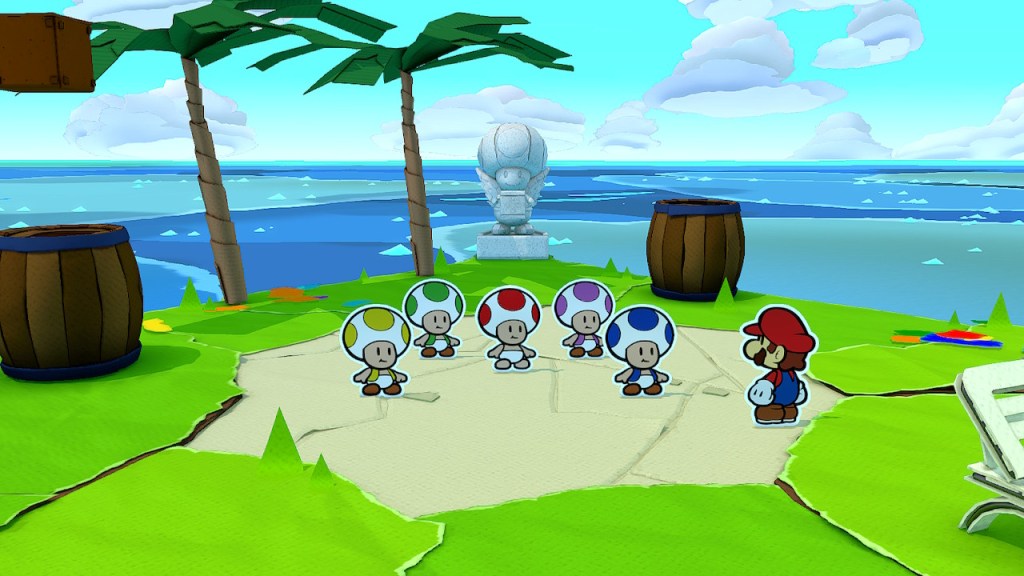
RETURN OF THE KING
Anyway, fug them, let’s talk about Origami King. The game is a brilliant iteration of that Paper Mario philosophy. It’s hilarious first of all. I didn’t expect to laugh as much as I did, playing into slapstick humour as well as being acerbic at times. It’s just brilliantly written.
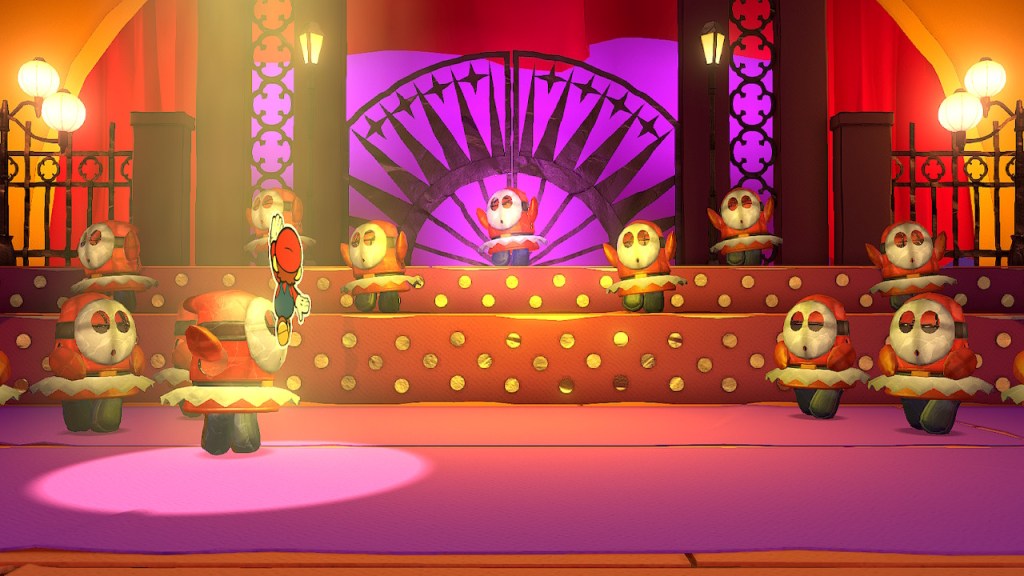
The areas and levels are varied too, willing to incorporate Mario homages as well as play into other Nintendo games. The Kuribo shoe is reimagined as a Kuribo buggy, driving around the dunes of the desert as you work out how to enter a hidden temple.
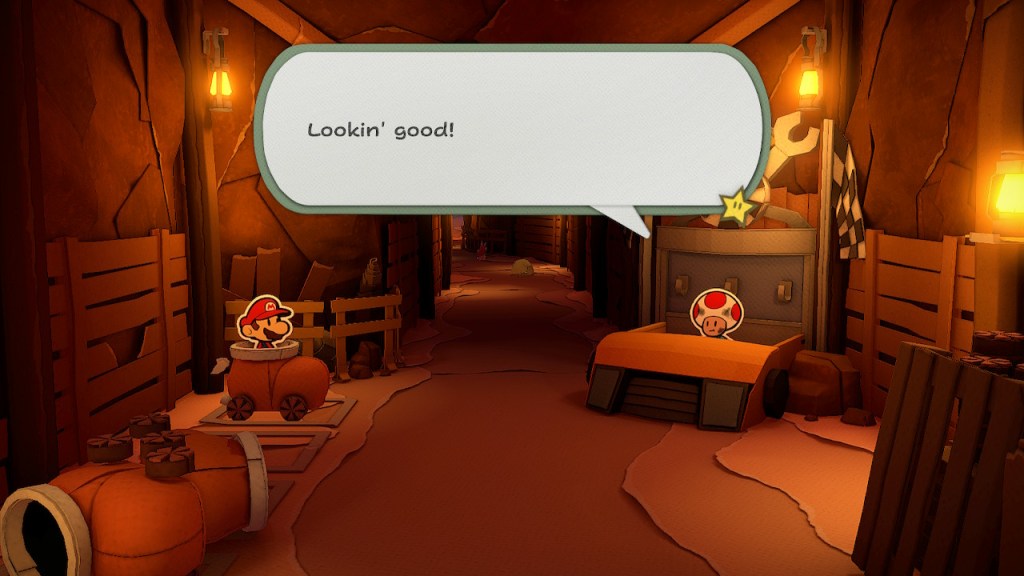
But it doesn’t end there – there’s a miniature Wind Waker-like segment where you captain a ship, stumbling across inventive islands, where exploration is rewarded with your map being marked with the locations of treasure.
There’s even a Star Fox like segment, flying through the air, commanding a massive cannon on Bowser’s Airship, shooting down paper planes acting like drones.

This is what I meant earlier about the game handling its heritage with fun.
In general, exploration is rewarded. Each area has 3 elements: finding Toads that are well hidden, covering up tears in the scenery and hidden ? blocks that are sneakily hidden in plain sight. These all contribute to that feeling of “completeness”.
Repairing the level helps do away with unsightly gashes, found Toads form a type of currency where you unlock art in the Musee Champignon and the hidden blocks provides you with money, items or even little trophies to commemorate what you’ve seen so far. Nothing is mandatory here, just like in the mainline Mario games. But it’s an added level of depth to reward those that are wanting to be a bit nosey.
The Battle System
Ok, this is where I admit that things aren’t as rosy as I’ve made it out to be. The concept is brilliant and a much needed change we’ve needed in turn based battles. Traditionally, you pick your move, you punch up a goomba, they pick their move, the goomba jumps on you. Slug it out until the goomba is mash-up.
In Origami King – you’re in a circular arena, divided into segments, where you twist and slide those segments in order to line up your enemies as best as possible. Bunching them up allows your hammer to strike them all, lining them up allows Mario to jump all over them. By successfully lining them up, your attacks do more damage too.
The concept is great and it truly does feel satisfying trying to work out these little puzzles in order to be as efficient as possible.
The issue – it doesn’t really iterate past that. While enemies might change, your approach and your abilities are almost identical to what you were using in the early game. It’s that lack of variation that can make the battle system feel flat (pun intended) as you progress.
Bosses also use a similar concept, with Chu Chu Rocket like arrows placed on the segments to guide Mario to his moves. I loved it during boss fights, that didn’t feel like it outstayed its welcome.
But with ordinary, humdrum enemies – the battle system needed a step-up, a little bit of zhuzh. Being occasionally accompanied with companions in the battles was not enough, however much fun it was to be shoulder to shoulder to Kamek and Bowser.
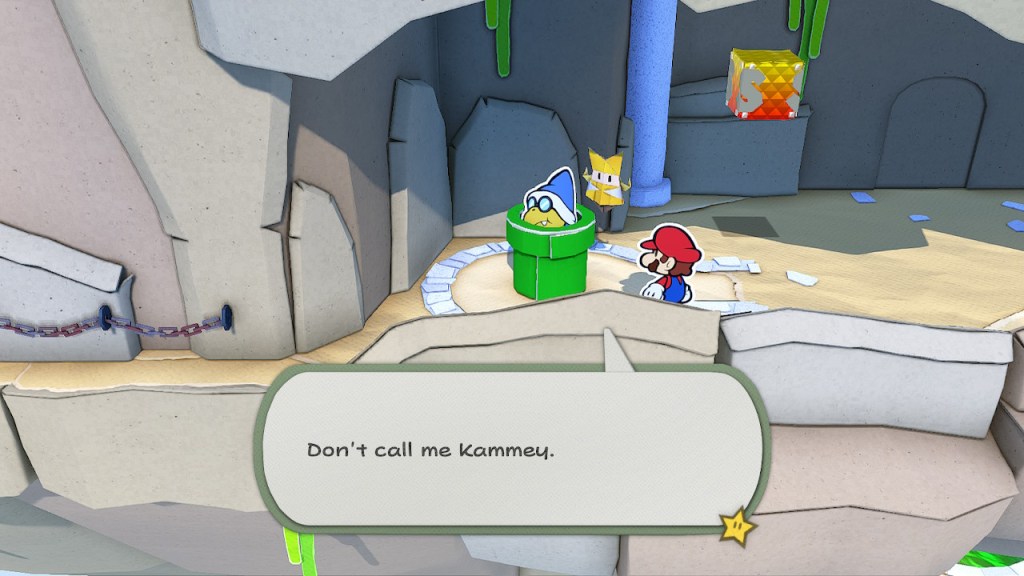
Overall[s]
Don’t let what I’ve written deter you from playing this game. In parts, it felt more similar to a Zelda game than it did a Mario game even. With the release of Thousand Year Door on Switch, I’m hoping for a new Paper Mario in the near future because my own apprehension was immediately eliminated after spending a few hours playing.
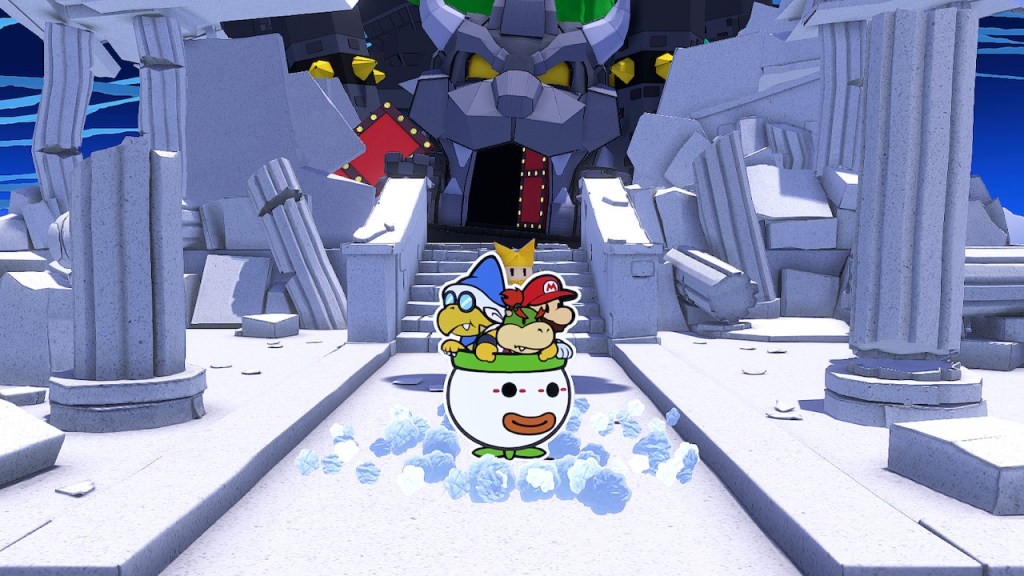
A wonderful game!
8 Hidden Blocks Found out of 10
 gamesandtings
Leave a comment